Sizing is the quiet decision that makes or breaks a custom sock order. Pick too few sizes and half your team is swimming in fabric or stretching a small over a size-12 foot; pick too many and you are sitting on leftover inventory in the sizes nobody wore. Because knit socks stretch, the math is not as simple as matching one sock to one shoe size, and the right answer depends more on your order volume and who is wearing them than on any universal chart. This guide explains how bulk custom socks are actually sized and how to order a range that fits your group without overbuying.
Why sock sizing is a range, not a number
A knit sock is engineered to stretch, so every size is really a span of shoe sizes rather than a single fit. That is why custom sock programs are usually built around a small number of broad tiers instead of the S/M/L/XL granularity you would expect from apparel. A widely used set of tiers looks like this: an Adult Small covering roughly US men’s 4 to 6 (women’s 5 to 7), a One Size Fits Most spanning about men’s 6 to 11 (women’s 7 to 12), and an Adult Large reaching men’s 11 to 14 (women’s 12 to 15). The chart below lays those ranges out side by side.
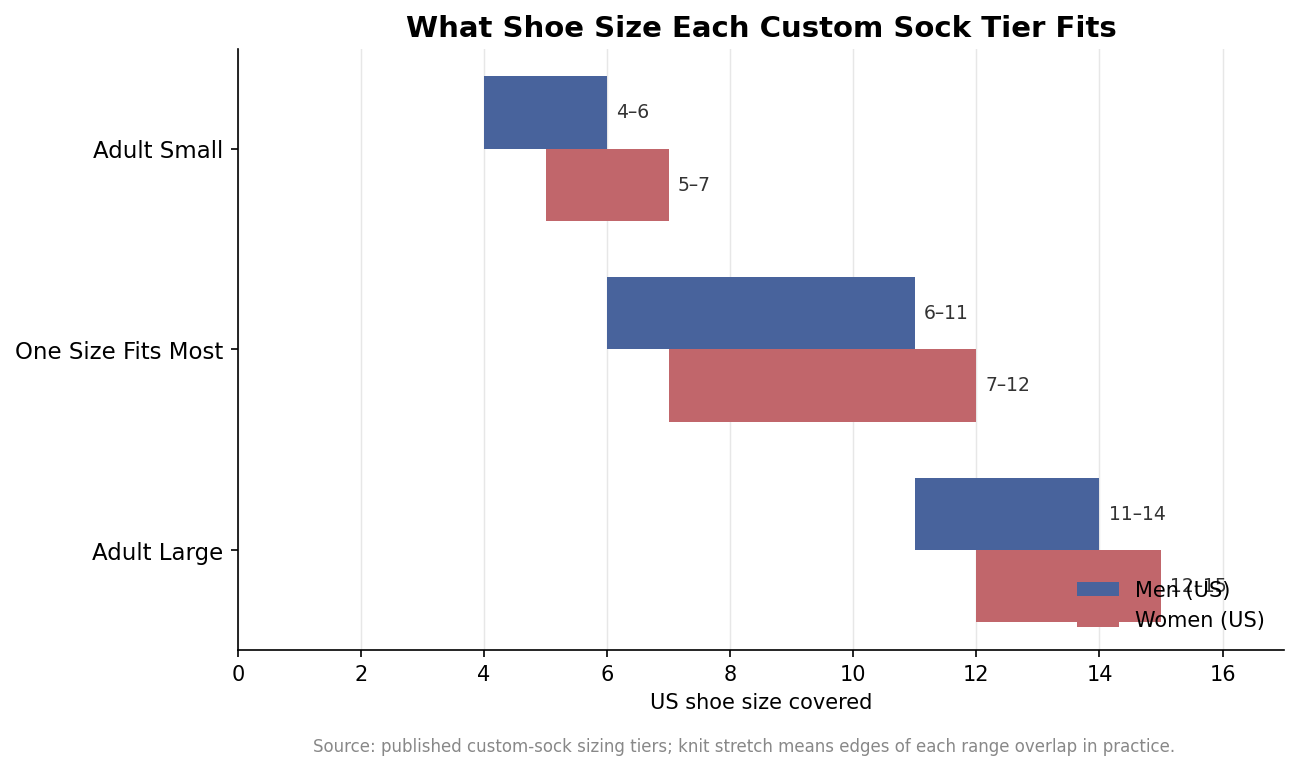
The overlap at the edges is intentional. A man with size 9 to 11 feet fits comfortably in either the one-size or the large, which means you rarely need to nail sizing to the exact foot. That forgiveness is what makes a single sock size viable for a whole group, and it is the reason sock sizing behaves differently from shoe or shirt sizing.
One size, two sizes, or three
The core decision is how many size runs to order, and it is really a trade between fit precision and inventory simplicity. A single one-size run is the simplest possible order: one SKU, no guessing who needs what, and no leftover odd sizes. It covers the broad middle of the adult range but leaves the smallest and largest feet less well served. A two-size split is the most common upgrade and handles almost everyone. Real catalog products are built exactly this way. One stock crew and ankle sock from AS Colour, for example, is offered in just two runs, a 4 to 8 US and a 9 to 13 US, which between them cover the bulk of adult feet with only two things to manage. A three-size range adds a dedicated small and large so you serve the tails of the distribution, at the cost of a third SKU and the risk of overordering a size your group barely needs. The chart below shows how each strategy covers the shoe-size axis, and where each one leaves gaps.
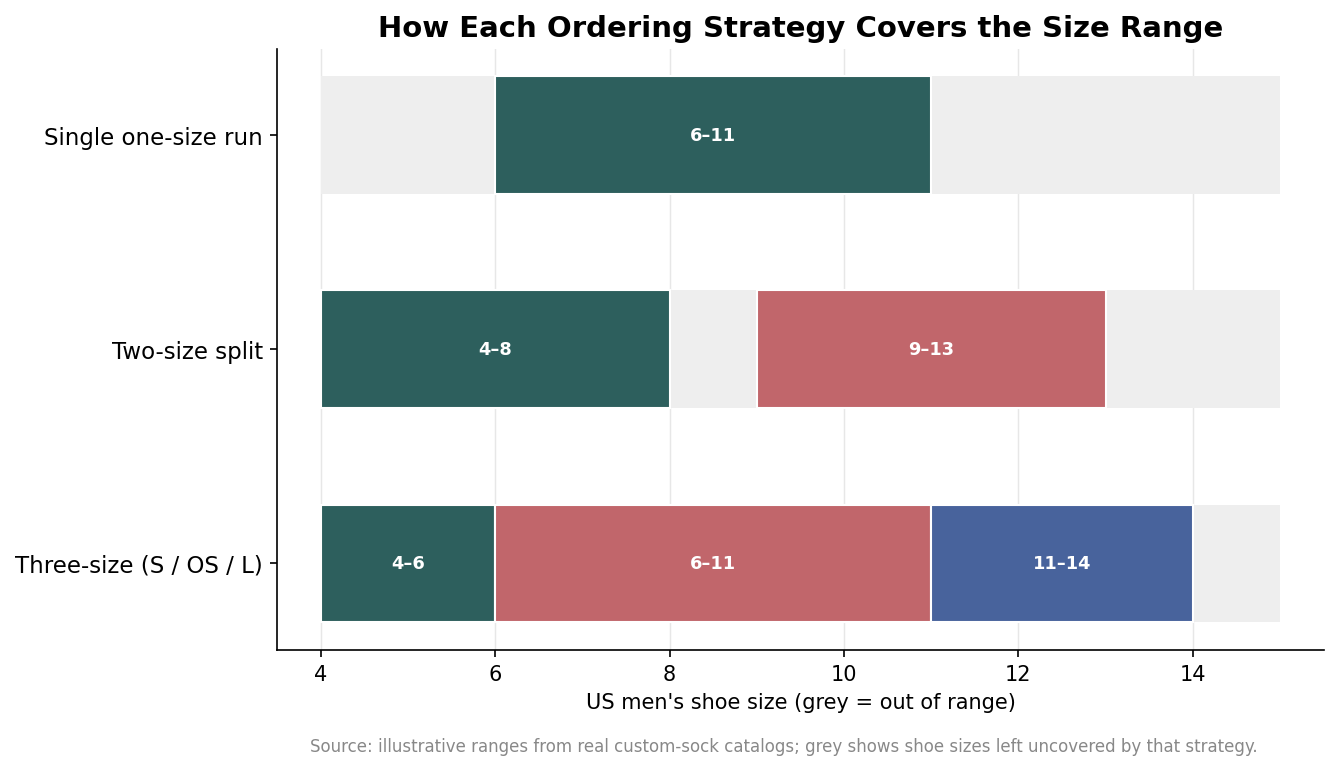
Match the strategy to the order. For most branded merchandise, giveaways, and team runs, one size or a two-size split is the sensible default, and many suppliers explicitly recommend one-size for orders under roughly 1,200 pairs because it removes the leftover-inventory problem entirely. The moment you know your wearers skew toward very small or very large feet, or you are outfitting a group with a wide range like a whole company, adding a small and a large earns its keep. Retail sock lines, where you cannot predict the buyer’s foot, are the clearest case for carrying three sizes.
What to tell your supplier
When you place the order, the supplier needs three things beyond the artwork: which size tiers you want, roughly how to split the quantity across them, and the sock height. On the split, a practical starting point for a two-size adult order is to weight it toward the larger run if the group skews male and toward the smaller run if it skews female, then even it out if you are unsure. On height, a true crew sock sits around 6 to 8 inches up the leg to mid-calf, which is the safe default for branded socks because it gives the most visible real estate for a logo; treat that as an indicative range, since exact leg length varies by knit and cuff. If you are matching an existing product, ask for the finished measurements rather than assuming, because a “crew” from one factory can sit noticeably higher or lower than another.
It also helps to state who is wearing them. Youth and toddler tiers exist for a reason, and a program for a school or a kids’ event needs those small sizes rather than a scaled-down adult sock. If your run mixes adults and children, treat them as separate size decisions instead of trying to stretch one range across both.
Common sizing mistakes
The most expensive mistake is ordering too many sizes out of caution. Every extra size tier multiplies your SKUs, complicates distribution, and usually leaves you holding the ends of the range, exactly the pairs that are hardest to give away later. Unless you have a specific reason, fewer sizes ordered in the right proportions beats a full size run you cannot fully use. The second mistake is assuming sock size tracks shoe size one-to-one and ordering a small because someone wears a size 7 shoe; in a stretchy knit, that person almost certainly fits the one-size, and treating the tiers as hard cutoffs leads to overbuying. The third is forgetting to confirm height, then being surprised when a “crew” order arrives sitting lower than the sample everyone approved.
Get these three right and sizing becomes the easy part of a sock order. Decide how many tiers your group genuinely needs, lean on the stretch built into every knit sock, confirm the height against a real measurement, and split the quantity toward where your wearers actually fall. Do that and you end up with socks people wear instead of a box of unclaimed sizes in the wrong end of the range.