When a custom crew sock goes wrong, the culprit is usually the decoration method rather than the design. Buyers pick a look they love, hand over the artwork, and only later discover that the method they were quoted could not reproduce the gradient in their logo, or that the socks they wanted for a hundred-person team came with a minimum order built for a thousand. Knit-in and sublimated printing are the two dominant ways to put a design on a sock, and they are not interchangeable. One builds the design into the fabric as the sock is made; the other prints the design onto a finished sock. That single difference ripples through color, texture, durability, minimum order and lead time, so it pays to choose the method before you fall in love with a mockup.
How each method puts the design on the sock
Knit-in means the pattern is the fabric. On a knitting machine, colored yarns are fed and interlocked so the logo and pattern are formed stitch by stitch as the sock is created. There is no ink and no coating; the design exists because different colored yarns occupy different stitches. Sublimation works the opposite way. The sock is knitted first, almost always in white, and the artwork is then transferred into the surface fibers with heat and dye so the color becomes part of the fabric face rather than sitting on top as a printed patch. Because knit-in commits the design during manufacturing, changing it means reprogramming the machine, while sublimation only needs a new digital file, and that contrast explains most of the practical differences that follow.
Color and detail: the clearest divide
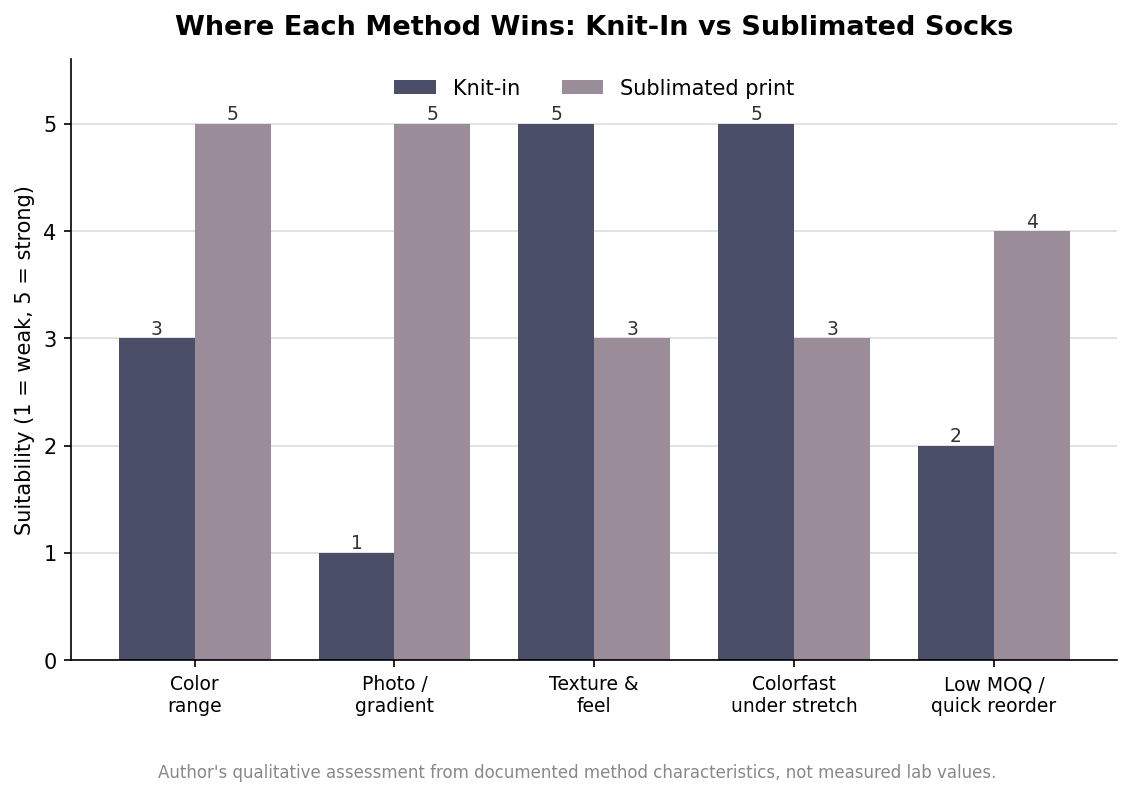
Nothing separates the two methods as sharply as color capacity. A knit-in design is limited by how many yarn colors the machine can carry at once, which in practice means a handful, commonly four to eight distinct colors in a single design. That is plenty for bold logos, stripes, argyle and clean geometric patterns, but it cannot produce a photograph, a smooth gradient or a fade from one shade to another, because there is no yarn that blends. Sublimation has effectively no color ceiling. It reproduces full-color artwork, gradients and photographic detail because it is a dye process rather than a yarn-selection process, so a design with a sunset behind a mascot or a mesh of overlapping brand colors is only realistic in print.
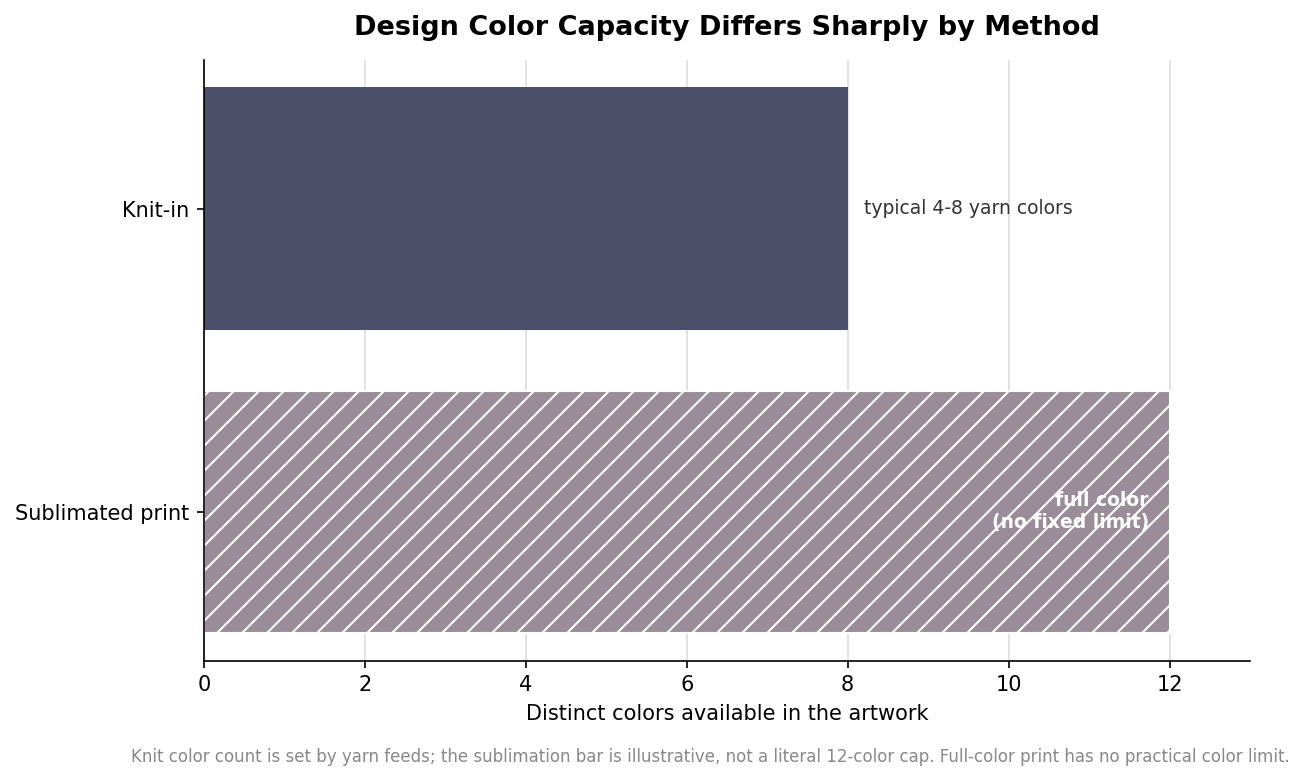
The rule of thumb is to let the artwork pick the method. If your design resolves to a small palette of solid colors and crisp shapes, knit-in will render it beautifully and with a quality that reads as premium. If the design depends on gradients, photographic elements or more colors than you can count on one hand, sublimation is the only method that will do it justice, and forcing that artwork into knit will mean redrawing it down to a few flat colors.
Feel, breathability and durability
The methods feel different in the hand and on the foot. A knit-in design has texture, because the pattern is made of raised, interlocking yarns; you can feel the logo. That structure also means the color is locked into the yarn itself, so it resists fading and holds up to repeated washing without the design breaking down. Sublimation leaves a smooth surface, since the dye lives in the fibers rather than adding a layer, which some wearers prefer for a clean, uniform look. The trade-offs are subtle but real: the dye can marginally reduce breathability compared with bare yarn, and because the print sits in the surface fibers, heavy stretch across high-tension areas like the heel or toe can show slight dye diffusion over time. Neither method is fragile, but if maximum colorfastness through hard, frequent laundering is the priority, knit-in has the edge.
Runs, lead times and sizing
Setup is where budgets and calendars are won or lost. Knit-in carries more front-end work, because the machine has to be programmed and threaded with the right yarns before the first pair comes off, which pushes both minimum order quantities and lead times higher. Sublimation swaps a digital file instead of reloading yarn, so it turns around faster and supports lower minimums, which makes it the natural fit for short runs, frequent design changes and quick reorders. Sizing differs too. Knit socks are knitted to size, typically offered in a small set of ranges such as a smaller US four-to-eight and a larger nine-to-thirteen, so the fit is built in. Sublimated socks are printed onto pre-made blanks, which means the available sizes follow whatever blank stock the design is printed on, and very large or unusual designs sometimes need to be scaled to fit each size cleanly.
Choosing the right method
Put the two side by side and the decision usually makes itself. Choose knit-in when your design is a clean, few-color logo or geometric pattern, when you want a textured, premium hand-feel, and when durability through heavy washing matters more than turnaround, accepting a higher minimum and a longer lead time in exchange. Choose sublimation when the artwork needs full color, gradients or photographic detail, when you are ordering a smaller quantity or expect to change the design often, and when speed matters more than a raised, tactile finish. The chart below summarizes where each method is strong, but the shortcut is simply this: count the colors and complexity in your artwork first, and let that count point you to the method before you commit to a quote.